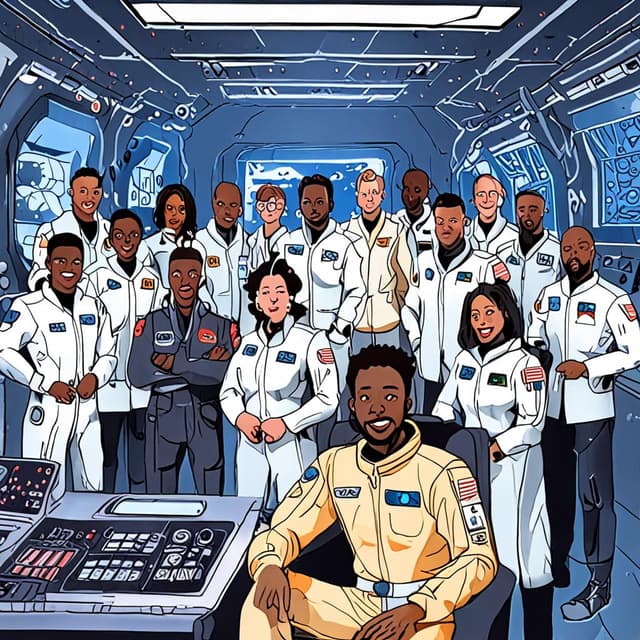
| Name | Diverse Celestial Unified Space Service (D.C.U.S.S.) |
| Goals | Coordinate space exploration • Promote global scientific cooperation • Represent the diversity of humanity in space |
| Founded | 1982 |
| Key achievements | Established a long-term orbital station • Sent astronauts to the Moon |
| Founding countries | Developing countries and smaller space-faring nations |
The Diverse Celestial Unified Space Service (D.C.U.S.S.) is an international space agency founded in 1982 as an alternative to the space programs of the United States and Soviet Union. Backed by a coalition of developing nations, the D.C.U.S.S. was established with the goal of coordinating space exploration, scientific research, and manned missions in a cooperative, peaceful manner that better represented the diversity of humanity.
The origins of the D.C.U.S.S. can be traced to the 1970s, when increasing numbers of newly independent nations and smaller space-faring countries became frustrated with the dominance of the Cold War superpowers in space. Nations like India, Brazil, Nigeria, and Egypt sought to assert their own presence and interests beyond Earth's atmosphere.
In 1980, representatives from over 50 countries convened in New Delhi to discuss the creation of an alternative international space program. After two years of negotiations, the Diverse Celestial Unified Space Service was formally established in 1982, headquartered in Bangalore, India. The founding members included India, the Soviet Union, Mexico, South Africa, Indonesia, and Venezuela.
The D.C.U.S.S. was explicitly designed to be more representative of the global community than the U.S. NASA or Soviet Roscosmos programs, which were dominated by the interests of the superpowers. Its core principles included:
Since its founding, the D.C.U.S.S. has achieved several significant milestones in space exploration:
The D.C.U.S.S. has also become known for its diverse, international astronaut corps. As of 2022, over 100 men and women from more than 30 different countries have traveled to space under the D.C.U.S.S. banner. This includes the first African, Arab, and South Asian astronauts to walk on the Moon.
Today, the D.C.U.S.S. operates with an annual budget of over $25 billion, contributed by its 68 member states. Its current priorities include:
However, the D.C.U.S.S. faces ongoing challenges, including:
Despite these obstacles, the D.C.U.S.S. remains committed to its founding vision of a collaborative, representative, and peaceful future in space exploration. As the space age continues to unfold, the agency hopes to serve as a model for global scientific cooperation.
